Minneapolis Medical Facility Cleaning
Medical and dental cleaning in Minneapolis runs at a standard well above ordinary office work. Exam rooms, dental operatories, lab benches, and busy waiting rooms all demand EPA-rated disinfection, separate equipment for clean and contaminated zones, and bloodborne pathogen training on every crew member. Patriot Building Solutions cleans clinics, dental practices, urgent care, physical therapy, and chiropractic offices across the city, from the medical suites clustered around the University of Minnesota campus to the practices tucked into Uptown storefronts and the professional buildings along the county’s edge.
What Separates Medical Cleaning From Office Cleaning
Cleaning a Minneapolis medical suite is a categorically different job than cleaning an office down the hall. Every patient-contact surface gets disinfected at each visit: exam tables, chair arms, door handles, light switches, and the shared equipment patients touch on the way through. Color-coded equipment keeps contamination from traveling, red mop heads for restrooms, blue for clinical spaces, so nothing crosses over. Our crews carry bloodborne pathogen training under the OSHA standard, work in proper PPE, and handle segregated waste and incident reporting correctly. They also carry HIPAA awareness training, so charts and patient information they encounter stay untouched and get flagged to your staff rather than moved or read.
Product choice and dwell time are where medical cleaning is either done right or faked. Patriot Building Solutions uses EPA-registered disinfectants with documented kill times for SARS-CoV-2, MRSA, C. difficile, and the other healthcare-associated pathogens that matter in a clinical setting. Different surfaces take different chemistry: quaternary ammonium for hard surfaces, peroxide-based products for sensitive electronics, and stronger solutions for contained biohazard spots. Dwell time is not optional. Most of these products need several minutes of wet contact to actually kill what they are rated against, and a spray-and-wipe shortcut does not disinfect. We follow the labels, because in a medical space the label is the protocol.
Minneapolis has a dense medical footprint, from the clinics and specialty suites around the University of Minnesota campus to the dental and primary-care practices in Uptown and along the county’s professional corridors, and each of those settings runs a little differently. A high-volume urgent care needs a crew that can move through exam rooms fast without cutting the dwell time; a quiet chiropractic or physical-therapy suite needs a lighter footprint that respects the treatment schedule. We match the crew, the frequency, and the products to the practice rather than running one generic clinical checklist everywhere. That is the kind of tailoring a national chain skips, and it is why a company our size holds a 99.5 percent retention rate across Hennepin County’s medical accounts.
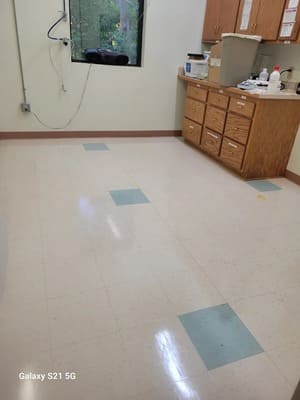
Clinic floors get chemistry decisions an office never faces. Sheet vinyl with welded seams is the clinical standard because it has no grout lines to harbor anything, and it needs a neutral-pH routine that will not degrade the welds or cloud the wear layer. Where a practice serves older patients, we keep finishes at a satin level instead of a wet-look gloss, because glare on a corridor floor reads as wet to an aging eye and changes how people walk. Small decision, real fall-prevention value, and the kind of thing a crew only knows if somebody taught them the why.
Respiratory season hits Minneapolis practices harder than the suburbs because patient density is higher and the same waiting room may serve walk-ins from a whole neighborhood. From late fall through spring we tighten the loop on our clinic accounts: disinfection frequency rises on the surfaces sick patients touch first, air-return grilles get added to the wipe list, and the crew lead confirms product stock weekly so a surge never runs the closet dry. Practices that want mid-day support during peak weeks can add a porter pass without renegotiating the contract.
Trained. Equipped. Certified.
Disinfection done to protocol
Hospital-grade product, the right dwell times, and crews in proper PPE. When the job is patient safety, the details are the whole job, not a checklist item.
Exam Rooms, Labs, and the Lines We Do Not Cross
Minneapolis exam rooms get cleaned between patients on heavy-volume days, deep-cleaned at end of business, and thoroughly reset on a weekly cycle. Lab spaces need separate equipment so nothing crosses from clinical work to the bench, along with the right decontamination steps for benchtops and safety cabinets. There is a hard line we hold: true sterile zones are cleaned by facility staff trained specifically for sterile work, not by a general commercial crew, so we do not touch those. Most Minneapolis practices, including the suites around the U of M and the busy Uptown offices, run clinical-not-sterile spaces, and those are exactly what we handle every night. Certificates of insurance go into the building file whenever a property manager or practice needs one on record.
Waiting rooms and restrooms carry more of the infection-control load than most practices credit, and they are where a medical clean either earns trust or loses it. A pediatric or primary-care waiting room near the U of M sees sick patients back to back all day, so the chairs, arm rests, toys, check-in counters, pens, and door handles all get disinfected with the same rated products and dwell times we use in the exam rooms, not a quick wipe on the way out. Restrooms in a clinical building are held to a higher bar than an office restroom, because the people using them are already unwell, so every fixture, dispenser, and floor gets full attention on each visit. Winter piles on here too: the salt and slush tracked into an Uptown storefront clinic or a U of M district suite lands right in the lobby, so from November through March the entry mats and waiting-room floors get extra passes to keep the salt from hazing the finish and to keep a wet lobby floor from becoming a slip risk for patients on their way in.
Therapy and behavioral practices ask for a quieter version of all this, and they get it. Fragrance-free products, no equipment noise during evening appointment blocks, and a crew that understands a treatment room is a private space even when it is empty. Physical therapy suites add their own surface list: mat tables, band and weight storage, parallel bars, and the gym-style equipment that behaves more like a fitness floor than an exam room. We wipe patient-contact equipment with products rated for skin-contact surfaces, and we schedule around the last session of the night, whenever that turns out to be.
Scheduling Around Patient Flow
A Minneapolis clinic cannot be cleaned like a warehouse, because the schedule has to bend around patients, not the other way around. Most of the work happens after the practice closes for the day, with light between-patient touch-ups on the highest-turnover exam rooms when the schedule calls for it. High-volume dental and urgent care offices near the U of M often need multiple resets in a single day; a smaller specialty suite in Uptown might run a thorough end-of-day clean and a deeper weekly cycle. We walk the space with the practice manager, learn where the chart rooms are, where the clinical-versus-sterile boundaries fall, and how after-hours access works, then build a plan around your patient schedule and hold it. Winter adds salt and slush at the entry, so mats and lobby floors get extra attention from November through March.
What sets Patriot Building Solutions apart on a medical account is that you deal with a real company, not a rotating cast of subcontractors and a customer portal. When a practice manager has a question about a protocol or needs to adjust the schedule around a change in patient volume, they reach Israel directly. We are veteran-owned, and Israel carries Six Sigma, HAZMAT, and First Responder training, which shows up in how the crews are trained and how consistently the standard holds. Every crew member is background-checked, and we carry full liability insurance and workers compensation, with a certificate of insurance available for the building file whenever a property or practice needs one. We stand behind the work with a straightforward guarantee: if the clean is not right, we return and correct it, and if we still cannot make it right, you get your money back. That is part of why 99.5 percent of our customers have stayed with us for three years running. Browse our gallery to see the results we leave across Hennepin County.
Training is what holds all of it together across a growing crew. Every cleaner on a medical account completes bloodborne pathogen, PPE, and product-use instruction before their first clinical shift, then refreshers on a recurring cycle, and the records sit in the account file where a practice manager or surveyor can ask for them. I would rather over-train and slow an onboarding by a week than put an unprepared person in a clinic. That patience costs us a little speed and buys the client a crew worth trusting.
Ready for Minneapolis medical facility cleaning?
Call us, send a message, or browse our gallery to see real Twin Cities work.
We do not chase complaints. We check in before they happen. That is how a cleaning company keeps 99.5 percent of its clients for three years running.
Israel, Founder & Marine Corps VeteranMinneapolis Medical Facility Cleaning FAQ
Do you clean dental offices near the U of M?
Yes. We clean Minneapolis dental practices across the city, including the cluster of suites around the University of Minnesota campus: operatories, sterilization areas, lab spaces, waiting rooms, and restrooms. Operatories get EPA disinfection between patients from dental staff, plus a thorough end-of-day clean from us.
Is your crew HIPAA aware?
Yes. Every crew member on a Minneapolis medical account completes HIPAA awareness training. Charts, documents, and patient information found during cleaning are left untouched and flagged to your staff if anything is at risk of exposure, never moved or read.
Do you handle biohazard cleanup?
We clean clinical areas after a biohazard incident has been contained and properly disposed. Active cleanup of large blood spills or hazardous chemical contamination requires certified biohazard remediation specialists, and for those situations we refer you to a licensed Minneapolis remediation company rather than improvising.
Which parts of a medical suite will you not clean?
True sterile zones. Those are cleaned by facility staff trained specifically for sterile environments, not by a general commercial crew, so we stay out of them. We handle the clinical-not-sterile spaces that make up most of a Minneapolis practice: exam rooms, operatories, labs, waiting rooms, restrooms, and common areas.
Do you disinfect the waiting room the same way as the exam rooms?
Yes. In a Minneapolis clinic the waiting room sees sick patients back to back all day, so the chairs, arm rests, check-in counter, pens, toys, and door handles get the same EPA-registered products and the same respected dwell times we use on patient-contact surfaces in the exam rooms. It is a high-transmission space, not a low-priority one, and we treat it that way on every visit.
Can you start cleaning quickly?
Most Minneapolis medical contracts start within 7 to 14 days of signing: walk-through, written quote, contract review, supplies delivery, training on facility specifics like chart-room locations, sterile-zone boundaries, and after-hours access, then the first cleaning night. Call (651) 412-3830 to set up a walkthrough.
Can you support between-patient room turnovers?
For high-volume Minneapolis clinics, yes. Clinical staff usually handle the immediate patient-to-patient wipe-down, and we layer scheduled mid-day resets on top during surge season, then run the full disinfection clean after close. The split of duties gets written down during onboarding so nothing falls between your team and ours.
What happens if our clinic extends hours or adds providers?
The scope flexes with you. Tell us the new schedule and we re-map the cleaning window, add crew time where the patient load grew, and update the written plan. No restart, no new contract cycle, and the same crew keeps the account so the facility knowledge carries forward instead of resetting with a staffing change.
Do you use fragrance-free products in clinical spaces?
On request, across the whole account. Plenty of Minneapolis practices treat patients with respiratory sensitivities, and a lingering scent in a waiting room is a real clinical complaint, not a preference. The disinfectants stay EPA-registered with their full kill claims. Only the fragrance goes.
Other Minneapolis Commercial Cleaning Services
View all Minneapolis, MN services · See our work · Get a free quote
Service Area: Minneapolis, MN
We clean medical and dental practices across all of Minneapolis, MN, from the University of Minnesota district to Uptown to Northeast, along with the surrounding Hennepin County neighborhoods inside our range out of Inver Grove Heights.